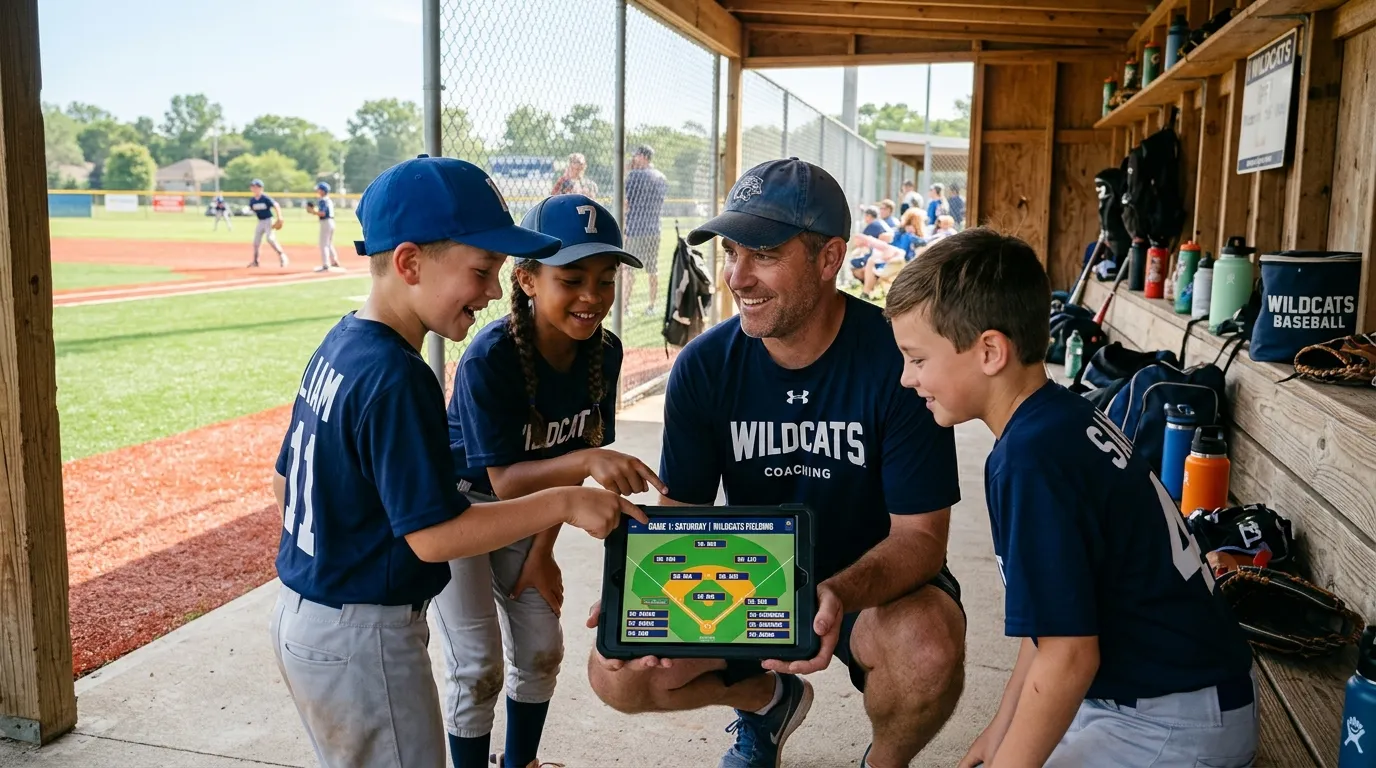
Quick answer: Volunteer baseball coaches struggle on game day because baseball demands two simultaneous lineups: a continuous batting order for the entire squad and an inning-by-inning defensive fielding plan across nine diamond positions. Wet paper clipboards, last-minute dropouts and complicated pitch-by-pitch scorebooks make game days stressful. You can eliminate the chaos by locking in parent availability before game day, visually assigning fielding innings on a digital diamond, and using a clean live running score tally that automatically notifies parents.
Every Saturday morning on community diamonds from Auckland to Austin, the same scene unfolds in the dugout.
A volunteer coach stands by the fence clutching a battered metal clipboard, a soggy piece of paper covered in scribbled names, and a golf pencil with a broken lead. Around them, twelve eager kids are asking who is batting first, three parents are asking where their child is playing in the field, and a text message just arrived from a family stuck in traffic.
Coaching youth baseball is one of the most rewarding volunteer roles in community sport. But when you are forced to manage batting orders, fielding rotations, player safety and scorekeeping on loose sheets of paper, game day quickly turns into an administrative marathon.
Here is why baseball team management is uniquely challenging on paper—and how volunteer coaches can run fair, organised, stress-free games.
The unique arithmetic of youth baseball
In most junior team sports, substitutions happen in blocks: quarters in netball, halves in football, or timed stints in basketball.
Youth baseball is different because it asks a volunteer coach to solve two separate puzzles at the same time:
1. The continuous batting order
In youth grades and Little League, leagues usually mandate a continuous batting order. Every player on the squad—whether you have 10, 12 or 14 players—bats in a set sequence from 1st to last. Even when a player sits on the bench on defence for an inning, they still take their turn at the plate when their spot comes up.
2. Defensive fielding by inning on the diamond
On defence, nine players take the field across distinct positions: Pitcher (1), Catcher (2), First Base (3), Second Base (4), Third Base (5), Shortstop (6), Left Field (7), Centre Field (8) and Right Field (9). In modified junior and Tee Ball grades, this might scale down to 6, 7 or 8 players.
Over a standard 6-inning youth game with a 12-player squad:
- There are 54 defensive fielding slots to assign (9 positions × 6 innings).
- An even share means each child plays 4.5 innings in the field—six players get 5 innings, and six players get 4 innings.
- Each player sits on the bench for 1 or 2 innings.
- Safety and development rules mean you must rotate players through the infield and outfield so nobody spends the entire season parked in Right Field.
Doing that arithmetic on the back of a clipboard while warming up your pitcher is where things fall apart.
The four classic dugout paper struggles
If you have coached baseball on paper, you have experienced these four moments:
1. The 10-minute pre-game dropout
You spent Friday night drawing up a neat spreadsheet with your batting order and fielding plan. At 8:45 AM, ten minutes before the plate meeting, a parent texts that their child has a fever.
Suddenly, your 12-player plan is an 11-player plan. On paper, you have to cross out batting spots, redraw arrows, and recalculate who sits on the bench in the 4th inning so you don’t accidentally leave an empty base on the diamond.
2. The third-inning fielding panic
Your team just struck out to end the top of the third. You have ninety seconds between half-innings. Two players are arguing about who is playing Second Base, your catcher is still putting on shin guards, and you are frantically scanning a damp scoresheet trying to remember who was scheduled to sit on the bench.
3. The post-game sideline interrogation
“Coach, why did Tommy play five innings in the field today while Caleb only played three?”
When you rely on scrap paper, you have no season-long record of who played where. You know you try to be fair, but without cumulative tracking, it is impossible to reassure parents that Caleb got five innings last week and Tommy sat out twice.
4. The scorebook intimidation factor
Youth baseball leagues often require a parent to keep score. But handing an untrained volunteer parent a traditional 50-symbol pitch-by-pitch paper scorebook—with balls, strikes, passed balls, foul tips and fielder’s choices—is terrifying. Halfway through the second inning, the parent scorer is overwhelmed, the pitch count is lost, and parents watching from work have no idea what the score is.
How to streamline game day in five practical steps
You don’t need a degree in sports administration to run an organised dugout. Here is how modern volunteer coaches eliminate paper stress:
Step 1: Collect availability before you touch a lineup
Never plan your batting order until you know who is actually showing up. Using an app with simple parent RSVP lets families tap “Attending” or “Absent” on their phones mid-week. When Friday night arrives, your squad list only contains confirmed players.
Step 2: Build your batting order once
Set a continuous batting order that rolls smoothly through the game. Ensure your batting order encourages quick base runners ahead of contact hitters, but rotate the order across the season so the same child isn’t always batting ninth.
Step 3: Map fielding innings visually on a diamond
Instead of writing a list of names and positions in rows, look at an interactive baseball diamond for each inning. Seeing your players placed at First Base, Shortstop and Centre Field makes safety and balance obvious at a glance. You immediately spot if you accidentally assigned a first-year player to catcher or forgot to fill third base.
Step 4: Track cumulative season innings
Fair playing time doesn’t mean every child plays the exact same number of innings in every single 6-inning game—the maths often doesn’t divide evenly. What matters is that over a 12-game season, every player finishes within one or two innings of each other. Tracking season totals takes the emotion out of parent discussions.
Step 5: Replace complex scorekeeping with a clean running tally
Unless you are running a high-school varsity programme with dedicated stat scouts, volunteer youth baseball doesn’t need pitch-by-pitch micro-tracking. A simple running score card that tracks runs scored inning by inning keeps the game moving, records the final result, and sends automatic score alerts to parents who couldn’t attend in person.
How Takaro supports volunteer baseball coaches
At Takaro, we built our baseball engine specifically to take the administrative headache out of community baseball and Little League:
- Interactive Baseball Lineup App: Drag and drop fielders directly onto an interactive baseball diamond for every inning, with automatic position scaling for 6, 7, 8 and 9-a-side formats.
- Continuous batting orders: Set your squad’s batting sequence in seconds, with bench players seamlessly included in the rotation.
- Ask Takaro AI Lineup Assistant: Short on time? Ask Takaro to generate a fair fielding rotation that balances infield and outfield time across your squad while skipping unavailable players.
- Live game-day scoring: Tap runs on the match page from your phone in the dugout. Connected parents automatically get push notifications whenever the lead changes and when the game finishes.
- Baseball Training Hub: 121 drills, practice plans and a 12-week season programme covering Tee Ball through to Senior grades.
- Free rules and position guides: Refresh on positions with our guide to baseball positions and official rules.
Volunteer coaching should be about teaching kids how to catch a pop fly, run the bases with confidence, and love the game. When you ditch the paper clipboard, you get your Saturdays back—and your players get a better coach.
Start managing your baseball team free on Takaro
Frequently asked questions
How do volunteer coaches manage batting orders and fielding rotations in youth baseball?
The most effective method is using a dedicated digital tool like Takaro. Coaches set a continuous batting order for the entire squad and assign fielding positions inning by inning on an interactive diamond. This prevents clerical mistakes and ensures bench rotations remain fair.
What is the fairest way to rotate players on a baseball diamond?
Calculate total defensive slots (number of innings multiplied by fielding positions, usually 9) and divide by the number of available players. Aim for no more than a one-inning difference between any two players across the game, and ensure every child rotates between infield, outfield and bench time rather than specialising at one position too early.
Do youth baseball teams need a pitch-by-pitch scorebook?
For introductory, junior club and Little League regular season games, a full pitch-by-pitch scorebook is often overwhelming for volunteer parents. A clean live running score tally that records runs inning by inning and final scores provides everything the league, coach and parents need without the stress.
How does Takaro handle last-minute player dropouts?
When a player marks themselves unavailable or doesn’t show up, you simply toggle them out of the lineup. Takaro adjusts your batting order and highlights any empty defensive positions on the diamond so you can fill them in seconds before the first pitch.
Is Takaro suitable for New Zealand baseball clubs and Little League?
Yes. Takaro is built in New Zealand and supports Baseball New Zealand (Baseball NZ) club structures, Little League NZ charters, and junior Kiwi Tee Ball and Rookie Ball formats. It is free forever for individual volunteer coaches.